Hangzhou
For a quick, inexpensive trip to an interesting city, consider Hangzhou.
travel time: 3 hours by high-speed train D3108 out of Wenzhou.
Places to go in the city:
West Lake (park, free)
Mausoleum of General Yue Fei (park and temple complex, 25 RMB)
6 harmonies Pagoda (pagoda and park complex, 30 RMB)
National Silk Museum (museum, free)
Ling Yin Temple (temple and park complex, 30-35 RMB)
Qing He Fang Street (shopping)
Places to go nearby:
National Tea Museum (museum, free)--located just west of West Lake in the incorporated village of Longjing.
Other things to do:
Try the local cuisine. Hangzhou culture has been influenced by many different groups over the centuries. The local specialties are braised pork and "beggars chicken," both of which are quite good if done properly. There is also a vibrant night life in this city and sunset marks the beginning of business hours for many pubs and bars as well as tea houses. Each one is unique and those around West Lake are rather nice to visit on hot summer days.
Wednesday, June 9, 2010


Friday, May 28, 2010
Summer travel
So summer is upon us and many foreigners in China are wondering, "what do I do now?" Here I have decided to post some recommendations for those who are living in various regions and may want to travel around China for a bit this summer before returning home. This is the first installment. In each posting, I will focus on one or two cities or regions. I have divided the categories by region, distance, and commuting options.
I'll start with Central China since that is where I am. These travel times are calculated from Wenzhou in Zhejiang Province.
Nearby:
For those who may not want to travel too much this summer, but still want to get out of the city there are several options.
1. Travel to Fujian Province
--2-3 hours by high speed train
*Places to go in the city:
--West Lake (park and traditional house with garden)--free
--Hualin Monastery (monastery, Hualin Lu, open for tours)--3RMB
--Pingshan Park (park, monkey park, Fufei S. Road)--free
--Yu Hill (pagoda, opera performances, Daoist temple)--free
--Gu Shan and Xi Chan Monastery grounds (monastery, vegetarian restaurant and shopping)--20RMB
*Places to go outside the city:
--Qingyun Shan Waterfall Park (park, scenic area, hiking)
--Qingyun Mtn. Royal Hot Spring Hotel (hotel, hot springs, mineral baths)--1200+ RMB/night
For more information about Qingyun Shan travel, visit http://www.tripadvisor.com/Travel-g297405-d1440226/Fuzhou:China:Qingyun.Mountain.html
I'll start with Central China since that is where I am. These travel times are calculated from Wenzhou in Zhejiang Province.
Nearby:
For those who may not want to travel too much this summer, but still want to get out of the city there are several options.
1. Travel to Fujian Province
--2-3 hours by high speed train
*Places to go in the city:
--West Lake (park and traditional house with garden)--free
--Hualin Monastery (monastery, Hualin Lu, open for tours)--3RMB
--Pingshan Park (park, monkey park, Fufei S. Road)--free
--Yu Hill (pagoda, opera performances, Daoist temple)--free
--Gu Shan and Xi Chan Monastery grounds (monastery, vegetarian restaurant and shopping)--20RMB
*Places to go outside the city:
--Qingyun Shan Waterfall Park (park, scenic area, hiking)
--Qingyun Mtn. Royal Hot Spring Hotel (hotel, hot springs, mineral baths)--1200+ RMB/night
For more information about Qingyun Shan travel, visit http://www.tripadvisor.com/Travel-g297405-d1440226/Fuzhou:China:Qingyun.Mountain.html
Saturday, April 24, 2010
Clean Air, Quiet City, and the Ability to Take a Deep Breath Part 2
In the morning, we were greeted with the sight of rain and grey skies, but the air was clean. I was able to draw a deep breath without inhaling a lungful of exhaust or smog. In Wenzhou, most mornings don't have a sunrise. If you can see the sun, it is through a brownish haze. In Fuzhou, even though the skies were dark and it was raining, one could not mistake the coming of day. In fact, the only thing that was remotely like Wenzhou was the brown river. The rain upriver causes the river in Fuzhou to turn brown due to run-off.


Guardian statue




Merged picture of the bridge and the river from the hotel.

Street Sweeper on a rainy day in Fuzhou.
After a quick breakfast of rice porrige, fruit, and some random sources of protein, we all leaded the busses again and set out in the rain for Fuzhou Botanical Garden.
The Botanic Garden is one of the places that I could have missed. It is a park where rare and native trees and plants are grown and protected, but unless you are interested in the history of the gymnosperm and can read Chinese, it is a rather boring place. The few bright spots included the huge Koi lake where thousands of Koi live, a huge old tree, the local temple, and the small children's amusement park across the road from the Botanical Gardens.
Once again, us four laowai ditched the main group to go our own way and wander through the park. I can imagine just how annoyed the guides were with us, but oh well, we were bored and tired of listening to the girl with the microphone speaking in a language that most of us couldn't understand. So we wandered off and found a small temple complex. The artwork and statues were far more interesting to us than a stand of Cypress trees or clusters of the world's tallest grass (bamboo). After visiting the temple, we headed to the far end of the park and saw a small amusement park. There the other three played a ring-toss game while I watched and took pictures. Again, far more interesting and much more fun than some rain-soaked trees.

Old tree

Koi pond

Out for a walk

Dragon roof

Buddha

Guardian statue

Another Buddha altar

Goddess of Mercy
After visiting the amusement park, we realized that the departure time was getting close so we started walking back to the other side of the compound, but we didn't realize how far we had come until we had 7 minutes left. Luckily we managed to hail one of the park tour taxis and the lady took us back to the east gate. We got back on time, before most of the other people in fact even though we had less than 1 minute remaining of our allotted time. While we waited for the rest of the group to return, we wandered around the food and gift stalls. I bought some pineapple and icecream. both of which were incredibly sweet. About ten minutes later, the rest of the group returned and we headed to West Lake.
West Lake is a lake in Fuzhou that has a park surrounding it not unlike Blue Lake in Oregon. It also has an old house and traditional garden that you can wander through. When we were there, there was a karaoke show going on in one of the pergolas. Although some of the singers had good voices, imagine traditional Chinese music done karaoke style; it's not easy on the ears. Other than that however, the lake had lots of trees, water and of course the garden. It would have been a beautiful place to visit if not for the rain. I would like to wander around the gardens when the sun is out. This time, Aaron (one of the guides) decided to stay with us the whole time. I can't imagine why...Unfortunately, we were pressed for time, so the stop at the lake was not a long one. After lunch at an overcrowded restaurant, we were taken to the final stop on our weekend journey--Old Street.
Old Street is a combination of preserved and reconstructed old buildings in Fuzhou. It is a relatively new attraction in the city as many of the buildings are still undergoing renovations. The side streets are also rather barren as of this point in time, but eventually the whole neighborhood will be one large "Historic Downtown" complete with shopping, restaurants, and numerous other businesses. Right now, it is a place with many interesting Ming and Ching style buildings and old houses-turned-shops that is fast becoming a tourist trap. The buildings are beautiful however and many of the smaller gift shops offer some unique small gifts that are easy to pack or send to relatives. I bought some matchbooks with Chairman Mao and Che Gueverra on them. I was tempted to buy some Obama ones, but those only came in a set of 28 and cost too much for matchbooks. Other people bought dolls, figurines, statues, and local pieces of art that were a little on the pricey side. One of my biggest discoveries actually took place just off Old Street.

Old Street

Bronze sculpture of writing

Ming/Ching Dynasty House

Ching Dynasty building

Bronze sculpture of silk screening

Really expensive wood statues

Bystanders on Old Street
After wandering around Old Street for a while, I returned to the busses with about 15 minutes remaining on our schedule. While I was standing there about to be bored, I saw a group of tourists dressed in nice clothes being led by a guide into what looked like another old building so I decided to follow them. What I found was an old private residence that was open to the public. Incidentally, this house was involved in the drug wars of the 19th century and part of the property is now an office for China's version of the DEA. It was a beautiful house, and even though the weather was still crappy I managed to get some decent pictures of the place. I wandered through corridors and hallways snapping photos of random sights; a courtyard, a statue, a Persian-style door, a bigger courtyard, a pond...Sadly I was not able to explore the whole house because I ran out of time. If I am ever back in Fuzhou, I plan on visiting both Old Street and this place again.

Entrance gallery

Small courtyard and pond

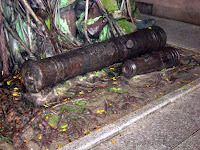
Cannons (from the 19th century Opium Wars)

Large courtyard and pond

Memorial plaques

Persian-style door
Unfortunately our rather busy, but interesting weekend had to end and before long we were all on the high-speed train back to Wenzhou. We arrived in Wenzhou to the fanfare of cars and smog and rain, but for at least a few hourse we were able to admire a clean city with clean air and take a big, deep, breath.
Clean Air, Quiet City, and the Ability to Take a Deep Breath
Last weekend, everyone in my office had the opportunity to go to Fujian Province as part of a group tour. We all looked forward to it if only because it was a chance to see somewhere that wasn't Wenzhou. I was interested in going only because it was my first time out of Zhejiang Province. We went to several places, but ultimately the tour was kind of boring mainly because we were always rushing from one place to another. The tour company tried to fit three or four days worth of activities into 38 hours. However it was still a chance to get out and see another part of China. I just wish it could have lasted a little longer or that we had not had to visit all of the places we went to.
The first place we went was of course the train station in Wenzhou. The new high-speed train will take you from Wenzhou to Fuzhou in just a few hours. The train ride was surprisingly nice and quiet. It was not crowded and provided a good opportunity to catch up on reading or sleep that was interrupted only by the occasional announcement that the next stop was some village or city. Almost as soon as we got out of the immediate area around Wenzhou, we noticed that the air pollution decreased significantly, even if the water still looked horrible. This was the first clue that anywhere other than Wenzhou might actually be clean. When we arrived in Fuzhou, the first thing we had to do was find our tour guides, a man whose English name was Aaron and a girl whose name I never knew, and figure out where the buses were. Once we got on the buses, the grand adventure began.


The first place we went was of course the train station in Wenzhou. The new high-speed train will take you from Wenzhou to Fuzhou in just a few hours. The train ride was surprisingly nice and quiet. It was not crowded and provided a good opportunity to catch up on reading or sleep that was interrupted only by the occasional announcement that the next stop was some village or city. Almost as soon as we got out of the immediate area around Wenzhou, we noticed that the air pollution decreased significantly, even if the water still looked horrible. This was the first clue that anywhere other than Wenzhou might actually be clean. When we arrived in Fuzhou, the first thing we had to do was find our tour guides, a man whose English name was Aaron and a girl whose name I never knew, and figure out where the buses were. Once we got on the buses, the grand adventure began.
After stopping for lunch in Linglu, the first stop on the tour was Qingyun Mountain Scenery Area. It is 76 km outside of Fuzhou near the town of Linglu in Yongtai county. The introductory sign was about the only legible English-language sign in the whole park. All of the other "bi-lingual" signs had such poor translation, grammar, and spelling as to make them virtually illegible. These signs became a source of great amusement for us four native English speakers on the trip. However, that being said, there were many wonderful scenic spots at this park. The four laowai on the trip (me + 3 others) were constantly climbing over rocks and stopping to take a look at some interesting piece of scenery to the point that the rest of the group got somewhat ahead of us and the guide, Aaron, was sent back to find us. He stayed with us for the rest of our climb up up the mountain because it might look bad if the four laowai got lost.

Cuvay, legislatu e, fear old?
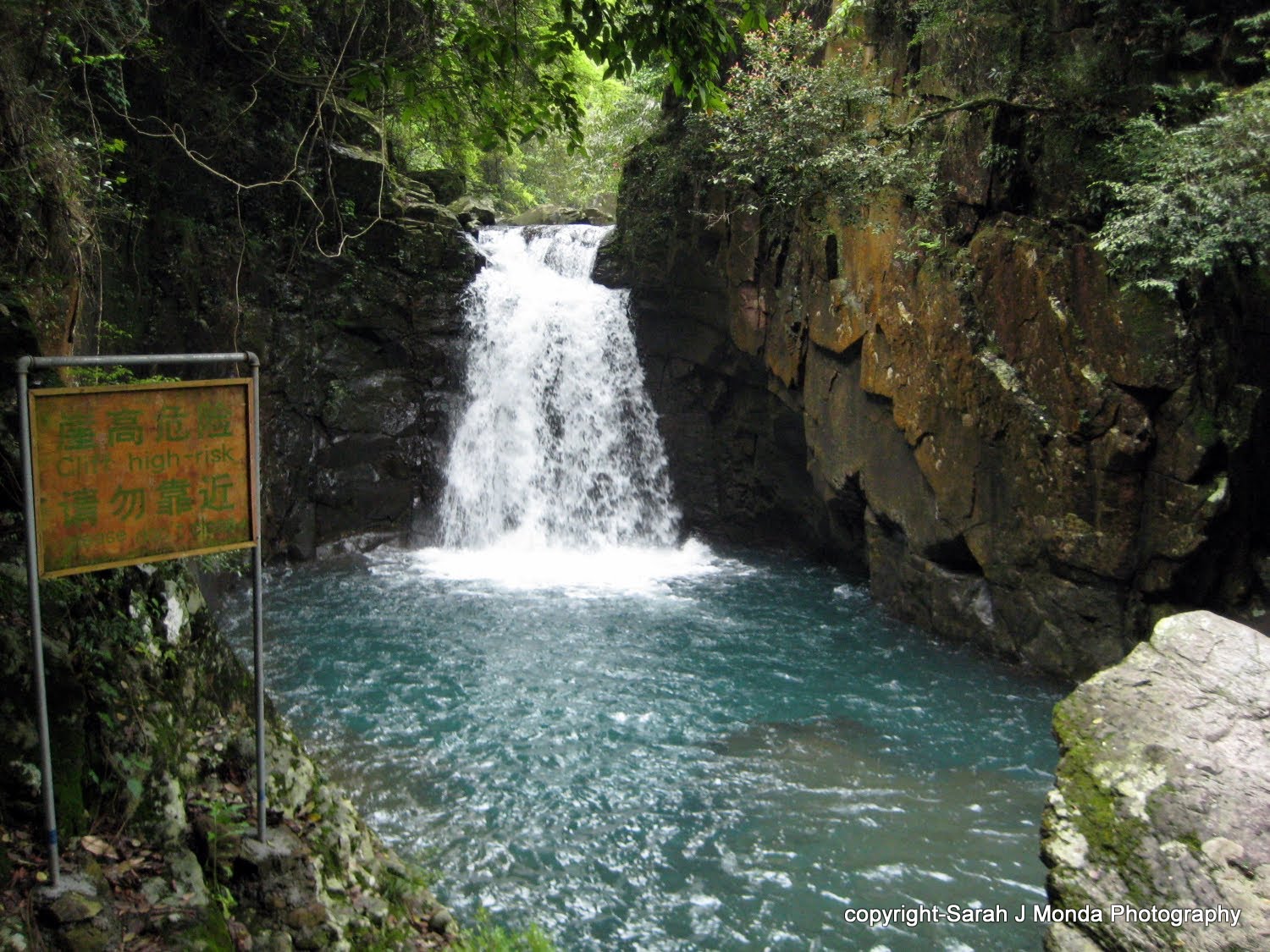


Top Left: One of many smaller waterfalls at the park. Top Right: The big waterfall at the end of the path up the mountain. Bottom: A small bridge across a small waterfall.
One thing that I will always remember about this park (other than the funny signs) is how clear, clean, and amazingly blue the water was. There is only one other place I have ever been where I have seen water of this color and that was in the Caribbean Ocean off the coast of Belize. I have never seen it in a mountain stream or river.
After wandering around for the better part of three hours, we went to the second stop on our journey--a wonderful hot spring hotel. This was the most relaxing part of our entire trip. Unfortunately, we were only able to spend a couple of hours there. I could have spent the whole day just going from mineral bath to tea soak to whirlpool and back. This hotel is very expensive to stay in. The cheap room will run about 1300 yuan per night, but people can go there just for the baths as we did. Now, for those who are thinking this sounds cool, It took us two hours by bus to get to the town of Linglu from Fuzhou. Not only that, but we could not drive the bus right up to the hotel because the road is only wide enough for cars, not busses, to pass so traffic jams are common. We ended up having to walk with all of our stuff the last 2.5 km or so from Linglu to the hotel.
After spending a couple of hours soaking in warm water, we went to dinner at the same place we ate lunch in Linglu. Once again we had to walk it. Not so fun after relaxing for a couple of hours in warm water, but the food was good and we got to eat out under what would have been stars if not for the rain clouds. After a good dinner, we got back on the bus for the two hour trip back to Fuzhou and our hotel. By the time we got to our hotel, almost everyone on the trip was ready to crash, but the four of us who were not Chinese decided to wander around for a while and see the city at night.

Looking out across the river from out hotel at a really expensive shopping place.

One of the bigger bridges in the city.

Night scene.
One of the first things we noticed about the city was how quiet it seemed at night. In Wenzhou a street like the one above would be filled with street carts and vendors. Cars would be moving along to the ever-present sound of horns and people would still be out and about. In Fuzhou, the scene is much quieter and the streets are much cleaner. Even during the day there are few street carts and the drivers are infinitely more polite than in Wenzhou. It was a nice contrast from the bustle of daily life in the city of Wenzhou. After wandering around for a bit and visiting the American embassy (aka McDonalds), we all headed back to our hotel for good night's rest.
To be continued...
Saturday, April 3, 2010
Easter
It's Easter Sunday (for us non-Eastern Orthodox folks). For those wondering what you can do on Easter Sunday in Wenzhou, here are some ideas...
1) For the religious among us, there are a lot of Catholic and Protestant churches in this area. There is one just southwest of Xialvpu that is painted red. Likewise there is another at the end of the 105 bus line. If you ask around, you will be able to find one pretty easily. Your students might even know where one is.
2) Host a party. Invite all your friends to your apartment for the day. You provide the main meal, but snacks, side dishes, and drinks can be easily covered by your friends. If you are really in the spirit, you can even decorate your place in Easter eggs and bunnies.
3) Go to a party. Convince you friend that they need to have a party at his or her place this time...
4) Go to La Luna or one of the other foreign hangouts. La Luna is a bar and grill that serves Mexican food, has good booze, free Wi-fi, and free pool. It is located at 温州帀江瑸西路永楠路5号. For those who don't read Chinese the translation is: 温州 = "Wenzhou" 帀 = zā (location article) 江瑸西 = "Jiang bin xi" (name of the road) 路 = "lu" (street/road) 永楠 = "Yong nan" (name of the road) 路 = "lu" (street/road) 5号 = "wu hao" (number 5). That is to say that La Luna is located at No. 5 Yong nan Rd. Jiang bin xi Rd. Wenzhou. If you get into a taxi and say, "Jiang bin xi lu, Yong nan lu wu hao," they should be able to understand. If all else fails, write the characters down and show them to the taxi driver.
5) Go shopping. No explanation needed, but I recommend taking someone with you who can read and speak Chinese so you can get the best deals.
6) Go to the movies. Check out what movies are playing and then head to the local theater with a friend or two in tow.
7) Girls (or boys) Night! Invite all your friends of the same sex over to your place and spend the evening talking, hanging out, watching movies, or going shopping or whatever you decide to do.
8) (I don't recommend this) Sit at home and be bored watching TV or movies.
1) For the religious among us, there are a lot of Catholic and Protestant churches in this area. There is one just southwest of Xialvpu that is painted red. Likewise there is another at the end of the 105 bus line. If you ask around, you will be able to find one pretty easily. Your students might even know where one is.
2) Host a party. Invite all your friends to your apartment for the day. You provide the main meal, but snacks, side dishes, and drinks can be easily covered by your friends. If you are really in the spirit, you can even decorate your place in Easter eggs and bunnies.
3) Go to a party. Convince you friend that they need to have a party at his or her place this time...
4) Go to La Luna or one of the other foreign hangouts. La Luna is a bar and grill that serves Mexican food, has good booze, free Wi-fi, and free pool. It is located at 温州帀江瑸西路永楠路5号. For those who don't read Chinese the translation is: 温州 = "Wenzhou" 帀 = zā (location article) 江瑸西 = "Jiang bin xi" (name of the road) 路 = "lu" (street/road) 永楠 = "Yong nan" (name of the road) 路 = "lu" (street/road) 5号 = "wu hao" (number 5). That is to say that La Luna is located at No. 5 Yong nan Rd. Jiang bin xi Rd. Wenzhou. If you get into a taxi and say, "Jiang bin xi lu, Yong nan lu wu hao," they should be able to understand. If all else fails, write the characters down and show them to the taxi driver.
5) Go shopping. No explanation needed, but I recommend taking someone with you who can read and speak Chinese so you can get the best deals.
6) Go to the movies. Check out what movies are playing and then head to the local theater with a friend or two in tow.
7) Girls (or boys) Night! Invite all your friends of the same sex over to your place and spend the evening talking, hanging out, watching movies, or going shopping or whatever you decide to do.
8) (I don't recommend this) Sit at home and be bored watching TV or movies.
Wednesday, March 31, 2010
Stress Relief
推拿 This is a phrase that many of us become very familiar with. It is pronounced "tuīná" and refers to a form of deep massage or "manipulative therapy." There are lots of places to go in Wenzhou that offer 推拿 but the one that I like best is directly between 2nd and 8th Communities in Xialvpu. If you walk across the street from 8th community and head into the side street that has a name but no one remembers it, look up and right and you will see a blue sign. If it is night, the sign may or may not be lit by yellow string lights. This is the massage parlor I prefer.
It is a little run down looking and quite frankly I would never have walked into it had I not been with a Chinese colleague the first time. It is a little intimidating. When you walk in, the entry room is long and narrow with a series of foot massage chairs along the right hand side and a counter at the back. Usually there are at least three people sitting in the chairs either sleeping or lounging. These are the "masseurs" (although most are female). Sitting at the desk is an older man who looks to be about 55 or 60. Sometimes he wears glasses, sometimes not. He is the one in charge of the books for this joint. There is no menu. Customers must know what they want.
After telling him I want a back massage 背部推拿 (bèibù tuīná)he points up the stairs. The stairs are rather steep and they split at the top into a "Y." To the left is room that I know to be full of more massage chairs, although exactly what they are used for is anyone's guess. To the right is my destination. This room is divided into several areas by cubicle walls. Each area has two or three massage beds in it. I choose one and take off my.....shoes (get your mind out of the gutter). If I am wearing a jacket I remove that also, but the rest stays on. Right behind me is my "masseur." Now for bèibù tuīná I've discovered that there are only a few people who actually do this at this particular place; I think this has to do with the fact that the person needs some experience to know how hard to push and when to stop. After I choose my bed I lay face down. The "masseur" then places a white sheet over me and begins to work her magic.
To begin, she starts at the head or neck and it can be painful your first time, especially if you are really tense. Next come the shoulders and upper arms followed by the upper back. By now, the "masseur" has resorted to using her elbows rather than her hands; the better to get those tough muscles that we use for vertical movement to relax. She then works her way slowly down the back until the gets to my tail bone. Then she does a quick massage of first one side and then the other before moving on to the back of the legs and feet. When all of this is done, she does the once-over head to toes. This is the end of the bèibù tuīná. It is not the end of my massage however.
If there is time, she tells me to turn over onto my back. Once I have managed to flip myself over using muscles that are way too relaxed to accomplish this gracefully, she begins to massage my neck and shoulders again, but from a different angle. Then she moves up to the head and scalp, grabs my head firmly and gives long tug. This is one of my favorite parts of the massage. I can feel all of my vertebra align themselves properly. She gently puts my head down. Next she massages my arms and hands right down to the finger tips. The final area she does is my legs. She pays particular attention to the quadriceps and IT bands that are always tight. Lastly, she lifts my legs and manipulates the hip joints; first one then the other. She also does this to my shoulders. Then I am done. For 15 yuan I have gotten a 45 minute massage that will last me until next week--or at least until I feel like going again.
If bèibù tuīná is too aggressive for you, here are some other forms of massage:
按摩 -- ànmó--literally "massage" just point to the area you want massaged. bèibù ànmó= "back massage"
头 -- tóu -- "head" or "top"
颈 -- jǐng -- "neck"
脚 -- jiǎo -- "foot"
NOTE: There are some things to remember about Chinese Massage parlors and spas.
Rule 1) Pink sign or lights=brothel
Rule 2) Blue lights or sign=legitimate massage parlor
Rule 3) Men will remove their pants at all massage parlors so if you don't want to see a middle-aged Chinese man in his skivvies, close your eyes.
Rule 4) You will often see patrons sleeping or hear their snoring. This is normal. It is OK to fall asleep, however I don't recommend staying there too long.
It is a little run down looking and quite frankly I would never have walked into it had I not been with a Chinese colleague the first time. It is a little intimidating. When you walk in, the entry room is long and narrow with a series of foot massage chairs along the right hand side and a counter at the back. Usually there are at least three people sitting in the chairs either sleeping or lounging. These are the "masseurs" (although most are female). Sitting at the desk is an older man who looks to be about 55 or 60. Sometimes he wears glasses, sometimes not. He is the one in charge of the books for this joint. There is no menu. Customers must know what they want.
After telling him I want a back massage 背部推拿 (bèibù tuīná)he points up the stairs. The stairs are rather steep and they split at the top into a "Y." To the left is room that I know to be full of more massage chairs, although exactly what they are used for is anyone's guess. To the right is my destination. This room is divided into several areas by cubicle walls. Each area has two or three massage beds in it. I choose one and take off my.....shoes (get your mind out of the gutter). If I am wearing a jacket I remove that also, but the rest stays on. Right behind me is my "masseur." Now for bèibù tuīná I've discovered that there are only a few people who actually do this at this particular place; I think this has to do with the fact that the person needs some experience to know how hard to push and when to stop. After I choose my bed I lay face down. The "masseur" then places a white sheet over me and begins to work her magic.
To begin, she starts at the head or neck and it can be painful your first time, especially if you are really tense. Next come the shoulders and upper arms followed by the upper back. By now, the "masseur" has resorted to using her elbows rather than her hands; the better to get those tough muscles that we use for vertical movement to relax. She then works her way slowly down the back until the gets to my tail bone. Then she does a quick massage of first one side and then the other before moving on to the back of the legs and feet. When all of this is done, she does the once-over head to toes. This is the end of the bèibù tuīná. It is not the end of my massage however.
If there is time, she tells me to turn over onto my back. Once I have managed to flip myself over using muscles that are way too relaxed to accomplish this gracefully, she begins to massage my neck and shoulders again, but from a different angle. Then she moves up to the head and scalp, grabs my head firmly and gives long tug. This is one of my favorite parts of the massage. I can feel all of my vertebra align themselves properly. She gently puts my head down. Next she massages my arms and hands right down to the finger tips. The final area she does is my legs. She pays particular attention to the quadriceps and IT bands that are always tight. Lastly, she lifts my legs and manipulates the hip joints; first one then the other. She also does this to my shoulders. Then I am done. For 15 yuan I have gotten a 45 minute massage that will last me until next week--or at least until I feel like going again.
If bèibù tuīná is too aggressive for you, here are some other forms of massage:
按摩 -- ànmó--literally "massage" just point to the area you want massaged. bèibù ànmó= "back massage"
头 -- tóu -- "head" or "top"
颈 -- jǐng -- "neck"
脚 -- jiǎo -- "foot"
NOTE: There are some things to remember about Chinese Massage parlors and spas.
Rule 1) Pink sign or lights=brothel
Rule 2) Blue lights or sign=legitimate massage parlor
Rule 3) Men will remove their pants at all massage parlors so if you don't want to see a middle-aged Chinese man in his skivvies, close your eyes.
Rule 4) You will often see patrons sleeping or hear their snoring. This is normal. It is OK to fall asleep, however I don't recommend staying there too long.
Wednesday, March 24, 2010
Creating Lesson Plans
Calling all teachers out there...How do you organize your lesson plans? If you are like me you put a title at the top of the page, below it goes the topic(s) and a brief description to remind yourself that you are really seriously going to cover this topic today. Below that you list the activities in order and a brief description thereof. Correct? What about time tables? how long do you spend on one subject or activity? What if you teach 4 classes from the same textbook that have very different ability levels? What is a lowly laowai English teacher to do?
First, I'm going to outline my problem and then I'll talk about the solution.
Problem: We are required to submit lesson plans for the entire semester to the powers that be. These powerful people have decided that all lesson plans should look exactly alike regardless of the course they are designed for or who is teaching the course. The theory behind this is that other teachers or administrator years from now will be able to duplicate the lesson plans of today right down to the very last minute provided they have the same text books. Therefore the lesson plans are laid out thusly;
First, I'm going to outline my problem and then I'll talk about the solution.
Problem: We are required to submit lesson plans for the entire semester to the powers that be. These powerful people have decided that all lesson plans should look exactly alike regardless of the course they are designed for or who is teaching the course. The theory behind this is that other teachers or administrator years from now will be able to duplicate the lesson plans of today right down to the very last minute provided they have the same text books. Therefore the lesson plans are laid out thusly;
Title of lecture and class
Topic (what is being covered)
Goal (why this is being covered)
First half of class:
Activity 1:
Who is involved?
What are the rules?
How long will you spend on this activity?
Why are you doing this activity?
Support information for this activity (ie websites, resources, etc.)
Activity 2:
Who is involved?
What are the rules?
How long will you spend on this activity?
Why are you doing this activity?
Support information for this activity (ie websites, resources, etc.)
Second half of class:
Activity 3:
Who is involved?
What are the rules?
How long will you spend on this activity?
Why are you doing this activity?
Support information for this activity (ie websites, resources, etc.)
Homework assignment:
What is it?
Why this HW and not some other (how is it related to the topic or topics)?
What is the goal of this HW?
My problem is that an outline like this far too rigid for my classes. I teach one class in which everyone is fully capable of studying abroad in any English speaking country. I have another class where about half of the students would be able to do this. A third class that should go back to their freshmen year and re-learn everything. and a fourth class that is actually better in Listening than the class above them, but significantly further behind in their speaking abilities. How or why should I have a lesson plan tat is this rigid for classes that require a lot of adjustment?
My solution:
I don't use the format the school requires and this has ruffled a few feathers. I use a lesson plan format that is much more fluid and contains only the information I need do deliver an effective lesson to all four classes regardless of ability levels. I simply see no point in submitting the "standard" lesson plan when it is not something I would ever be able to use. My lesson plans look something like speech outlines, but with far more detail. I include entire paragraphs of relevant information that I want to make sure I deliver to my classes. I don't use timelines because I would never be able to use them in class. An activity that takes 5 or 10 minutes for my best class would take 30 minutes for my lower-performing classes. Therefore, I simply outline what activities I CAN use to support the lesson, but I don't make it a mandatory thing for ALL of the activities to be accomplished. To make sure the lesson is effective, I make sure that the most pertinent and necessary activities are in the first part of the lesson plan and other activities that are simply nice to have find a home at the end.
This seems logical to me since a lesson plan is really only a means to keep the teacher on track. It is never supposed to be replicated by others teaching different courses with access to different materials. I guarantee that none of the teachers in the future will be able to duplicate my lessons simply because they will not have access to the same materials (such as iTunes podcasts). I would have no problem with making a lesson plan using the acceptable outline, but I would then have to make another lesson plan that I would actually use in class.
Here is an example lesson plan from the school:
Objective: 1. To practice VOA news
2. Show Students English Slangs: pronunciation and sense
3. Make students do slang conversation
| Attendance | |
| VOA News: Students will listen to a VOA news report twice. They must answers questions in this format: -Who -What happened/story about... -When did the news event occur... -Where did the news event occur... -Why did this news happen... If the students did not finish they will have to do this as homework, then turn it in.. | 15 Min. |
| Assign Student Teacher Exercise Dates | 5 Min. |
| Slang PPT.
| 25 Min. |
| Slang Conversation:
| 20 Min. |
| Finish the Valentines day Simpsons. | 15 Min. |
Here is one of my lesson plans:
Listening class 07 March lesson plan
Turn in and review Homework.
Finish Stereotypes and prejudices work.
Introduce Accents of the British Isles.
Students should be able to distinguish between the two dialects. Students should also be accustomed to hearing various accents and dialects of English as TEM 4 preparation and for SA.
What is the difference between the standard British and Western Neutral American dialects?
English is a West Germanic language. This means that it derives from the Anglo-Frisian dialects of Northwest Germany and Netherlands. One particular dialect came to dominate all of the other regional dialects that were present in the British Isles before 1000 CE…
Continue this discussion with the PPT.
Play examples of BrE and AmE accents and dialects for the class.
Dictation exercise
Have students write down what they hear. What are the different or strange words? Are there different pronunciations? Call on random students to read back what they have written.
Go to this website and play the clip. Summarize what the girl is talking about. Write down at least 5 words that are unfamiliar to you and write the definitions. Your summary must be at least 5 full sentences.
____________________________________________________
I like my lesson plan, although I do see where they think the problems are. I simply operate differently than they believe all classes should operate. I do what is effective for my classes, not what some of the other teachers say is effective for their classes.
___________________________________________________
Update:
I have now taken to writing two lesson plans for each class. One to turn in and one to use in class. It's a royal pain in the backside, but it's what I have to do...
Update:
I have now taken to writing two lesson plans for each class. One to turn in and one to use in class. It's a royal pain in the backside, but it's what I have to do...
Any thoughts or opinions?
Subscribe to:
Posts (Atom)